
Agencies
Work that belongs to a client and hours that have to add up at the end of the month.
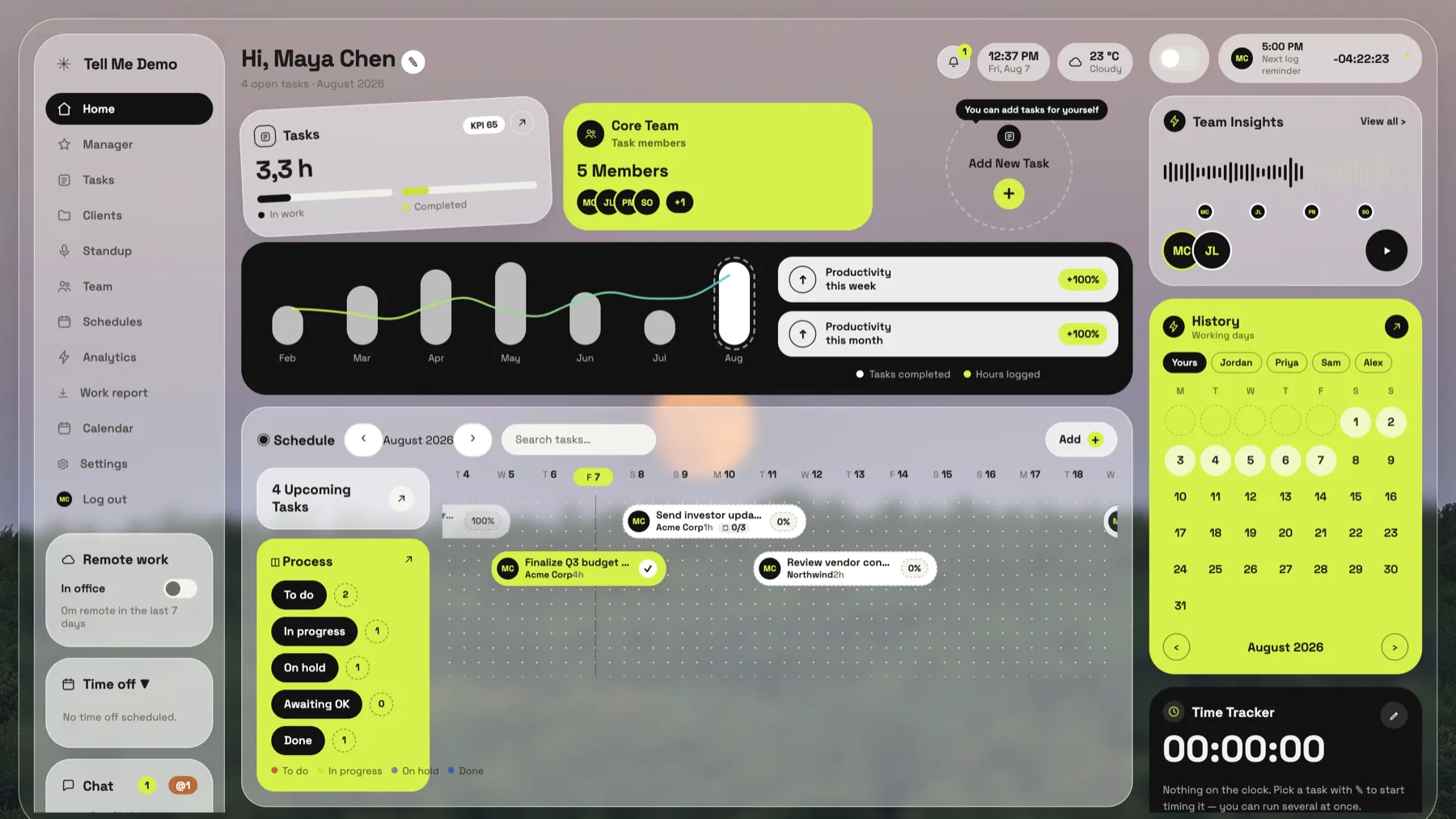
Everyone gets a dashboard of their own work — what’s due, what’s late, what’s waiting on someone else.
Managers get the hours per person and per client, ready to export. No chasing anyone in chat on a Friday.
Not because your team didn’t work. Because the work is in one place, the hours are in another, and the client the work belongs to is in someone’s head.
So the month ends and somebody reconstructs it: a spreadsheet, a scroll back through chat, a guess at what Tuesday was. It gets sent anyway. Everyone knows it’s approximate.
Not a video and not a slideshow — the product itself, with every screen in it: the dashboard, tasks, clients, the manager’s view, the schedule, the reports and the chat. No account, no email address, and nothing is saved.
Your people, your clients, your name on it. Nothing to install — it’s a web address, and an app on the App Store if you want it on a phone.
Add tasks, run the clock, tick things off. Nobody has to be trained into a methodology; the add-task flow is seven questions and most are optional.
Once a fortnight of work is in it, the report, the estimate accuracy and the per-client hours are worth reading — and the first month-end takes minutes.
Work that belongs to a client and hours that have to add up at the end of the month.
Five to forty people, one manager who’d rather not spend Friday reconstructing the week from memory.
Several clients at once, and a report each of them expects to see.
Tell us the team and we’ll set one up — your people, your clients, nothing else in it. Fourteen days, no card.